DENG Lab
Pursuing the Art and Science of Droplets

Printing Ceramic Sensors for Harsh Enviroments
We are developing a new technology for direct printing of low-profile ceramic sensors onto curved surfaces such as turbine blades. In the proposed process a liquid phase polymer precursor ink will be electrosprayed, cured, and pyrolyzed to yield a surface-conformed ceramic sensor element. To be amenable to printing, special consideration of the ink rheology and electrical conductivity is required. The research plan is a combination of experiments and modeling of the electrospray process with consideration of sensor functionality, device resolution and durability.
This project is a collabration with Prof. Linan An at UCF. It is supported by NSF (CMMI 1301099).


Optically Thick & Electrically Thin Nanostructure of Seminconducting Polymers
This projet is motivated by the need for realtime quality monitoring of the polymer solar cell manufacturing. We hypothesize that the solar cell efficiency is correlated to the "optical signatures" of the films. To test this hypothesis, we first fabricate a collection of benchmark semiconducting polymer thin film samples with unique inhomogeneous nano structures, which will be characterized using advanced off-line methods such as Grazing Incidence X-Ray Diffraction (GIXRD). The off-line data will be correlated to in-line optical signatures captured in real-time. The picture on the left shows the electrospray deposited P3HT nano pillars and the GIXRD image, which indicates significant component of desirable "face-on" orientation.
This project is a collabration with Prof. Andre Gesquiere at UCF. It is supported by NSF (CMMI 1335295).
Research
We focus our efforts to address three primary challenges in this area:
-
The challenge of generating small and monodisperse droplets at high throughputs.
-
The challenge of creating in-homogeneous nano/micro structure through spray deposition.
-
The challenge of understanding the process-structure-performance correlation from spray deposition.
Instability of Electrified Microjets
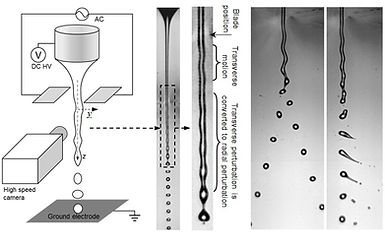
In electrified liquid jets, varicose instability leads to jet breakup into droplets while whipping instability is responsible for jet stretching. We show that the coupling and relative importance of these two instabilities dictates the outcome for jet breakup. The co-development of transverse and radial perturbations lead to remarkable breakup modes linked to initial perturbation magnitude, perturbation wavenumbers, and jet charge levels. This work was recently accepted for publication in Physical Review Letters and was featured as cover article.
Multiscale Surface Texture
A layer of liquid may undergo surface tension gradient driven instabilities and form the uniqe flow pattern of Bernard cells. This fast and scalable process enables us fabricate multiscale surface texture for various applications such as drag reduction and superhydrophobic coating. We study such mechanism for polymer solutions in volatile solvent such as acetone.

Evaporation of Levitated Droplets
We use Electro Dynamic Balance (EDB) to levitate a charged droplet so we can non-intrusively interogate and record the droplet evaporation history without contamination. This infomation is critical for a wide range of processes such as spray drying, deposition, and comubstion. The video shown here is a 70 micron glycerol droplet being levitated in our EDB. This project is a collabration with Prof. Ruey-Hung Chen.
